Welcome to Practical Sustainablity Solutions

This blog will provide the following functions to fulfill the requirement of environmental sustainability and FGCU University Colloquium's class in order to examine the current environmental, social, and economic situation. More importantly, based on these understandings supported by sound scientific evidence and reasoning, practical solutions to improve social and economic situations will be promoted for a mutually beneficial relationship.

Sunday, May 1, 2011

Journal Entry 11- Reflect upon the Corkscrew Sanctuary Trip

Reflect upon the Corkscrew Sanctuary Trip


The first stop on my trip through the Corkscrew Sanctuary was the most interesting to me.  The Living Machine is the essence of environmental sustainability.  The Living Machine incorporates natural filtration systems based on a series of tanks in which water is pumped through the various processes to become sanitized.  The very long process was actually developed to solve a waste management problem at the location as the guest facilities previously were not properly disposed of.  I found the process fascinating and this is a prime example of how technology can incorporate nature into cleaning up after humans, to reduce our impact, and even benefit the environment.  It was interesting to learn the ecological importance of Florida wildfires and how prescribed burns can actually prevent the loss of biodiversity.  The large alligator we saw was a good reminder that humans need to be careful when visiting deep swamps.  I really enjoyed the sounds of bird.  The construction of the wooden walkway with fire, rot, and insect resistant wood is an example of responsible building because building things that last reduce waste of valuable resources.  Corkscrew Swamp Sanctuary also has a great transition in between the ecosystems in the matter of feet.  The outdated board displaying population growth and urbanization is alarming to remember how humanity is growing exponentially and the resource demands will only continue to rise.  Even with a cultural change and extreme cutback on per person demands, the number of people will rise and overall consumption will continue to grow. 


Journal Entry 10- Free Market Resource Allocation

Free Market Resource Allocation

Will the Free Market ALWAYS Optimally Allocate Resources?


An entirely free market has no economic intervention.  This would include government regulation.  The enforcement of contractual obligations, protection of private property rights, and the ownership of property are important elements of a free market.  Private property ownership and rights need protected otherwise un-owned property becomes commonly (or collectively) consumed with no private interest to protect the resources of that property.  It is in these circumstances that the tragedy of the commons exists.  The resources being consumed will become depleted because individual gains will incentivize consumption without regard to long term overall effects.   Personal benefits outweigh the long term success of the many when property rights aren’t clearly defined or protected.  The solution to the tragedy of the commons would be to award property rights and protections into the market.   An example would be the buffalo and cattle populations over the course of American Development.  Historically property rights did not extend to live buffalo but rather stated that the point of ownership began when the animal was killed by the hunter.  Property rights were awarded to live cattle and were thus protected, bred, and multiplied by ranchers.  Over time even though more cattle was consumed than buffalo, cattle numbers continued to climb whereas the buffalo populations were hunted nearly to extinction.  No system is completely flawless and even in a typical free market economy (with limited intervention) externalities will exist; however, a free market economy will naturally outperform controlled markets.    


http://www.google.com/imgres?imgurl=http://www.freemarket-rs2010.com/typo3temp/pics/cc52d53492.jpg&imgrefurl=http://www.freemarket-rs2010.com/&usg=__PrXh8gXHX2_5AK2Que54hK6pfcI=&h=376&w=600&sz=26&hl=en&start=125&sig2=j-fRdOfhtU87ofx5LNy9hg&zoom=1&tbnid=8vWYR9ddnkMirM:&tbnh=150&tbnw=216&ei=fA69TYP8DpCftwee3-i0BQ&prev=/search%3Fq%3Dfree%2Bmarket%26hl%3Den%26safe%3Doff%26sa%3DX%26rls%3Dcom.microsoft:en-us:IE-Address%26rlz%3D1I7ACAW_enUS308US308%26biw%3D1325%26bih%3D672%26tbm%3Disch0%2C3824&itbs=1&iact=hc&vpx=818&vpy=383&dur=4412&hovh=178&hovw=284&tx=117&ty=134&page=8&ndsp=19&ved=1t:429,r:17,s:125&biw=1325&bih=672

Tuesday, April 19, 2011

Journal Entry 20- Colloquium Difficulties

Colloquium Difficulties
The high points in colloquium were the many connections with nearly all facets of society since it is the environment that sustains life and all that life demands.  Making the connections between what was the best for the environment and society.  Then examining the political and economical feasibility of the ideas presented.  I thrive off of the debate fostered in class since true learning comes not from accepting the bias presented to you, but rather receiving multiple sources of bias and facts to draw your own conclusions.  Debate brings up areas of weakness in arguments and many other influences into thinking.  I also enjoyed the freedom of our final project and in choosing our service learning opportunity.  I developed a leadership role in order to attain the service learning objective which proved useful to further my management skills and abilities and to become a leader promoting environmental sustainability.  I was able to choose a project that has always interested me.  Sustainable city planning was able to incorporate the knowledge and research gained throughout the course and the project and kept that material interesting to me.   It was difficult to study in depth the articles especially when they were not interesting to me.  I also struggled with the biased movies presenting political sides rather than addressing the environmental problems with solutions which we needed.  Being able to apply knowledge and facts to back up my position will allow me to make stronger arguments for my personal and business practices in the future. 

Journal Entry 19- The Meaning of Colloquium

The Meaning of Colloquium
The largest challenge in education aside from learning the material is the proper application and use of that knowledge.  My personal standpoints and beliefs are based off of the facts and knowledge I’ve gained.  University Colloquium in that sense has attempted force me to conform the ideology suggesting a personal and cultural change along with a sense of urgency to change behavior to avoid an already inevitable environmental disaster.  I did gain valuable knowledge on the inter-connected human activity and the effects on the environment.  The knowledge applied to my personal life allows me to make small behavioral adjustments to ease my own personal impact (demand for energy and resources) without a major lifestyle or standard of living adjustment.  Common sense solutions to become environmental friendly should be promoted to achieve sustainability.  Academically the course is a graduation requirement and does not specifically benefit me aside from a renewed sense of environmental awareness similar to that of other classes.  University Colloquium doesn’t directly apply to my degree being a Business Management Major.  I would have preferred a Colloquium class customized to benefit the major colleges which would concentrate focus on a more direct connection to my career pursuit.  There was related information which will prove useful in the business environment because business involves human capital (influenced by social factors), resources (both energy and ecological), as well as economics (also influenced by the other factors).  Business opportunities will appear when environmental changes create demand; similarly business operation must be sustainable to provide for long term strategic planning. 


Journal Entry 18- The Human Impact

Surviving the Human Impact
The overall human impact is vastly underestimated by many.  The behavior and impacts of a single individual may be so small, but people do not realize the vast quantities of humans.  Every ecosystem has a set carrying capacity.  The same is true for the earth and humans.  The colonies here can only sustain a set number of demands on the ecosystems before destruction will naturally occur.  This destruction can take place with the loss of natural resources that sustain plants and animals, and/or through natural disasters such as fires caused by drought (water overconsumption), or other naturally occurring disasters exemplified by human impacts on the earth’s resources.  The global populations numbering in the billions are barely sustainable since the vast majority of humans live in poverty in proportions vastly below the American standard of living.  Efforts to make necessary changes are definitely attainable however saving humanity as a whole and the standard of living of modernized humans is not possible, especially with the exponentially expanding size of populations.  Thus creates the moral dilemma and the ever present philosophy that the fittest survive.  The modernized nations are able to utilize education and technology to make life sustainable without compromising living standards.  This will not be true for underdeveloped and struggling nations simply because the resources are not plentiful enough to be sustained in higher levels.  Nations currently under development including developing markets should be trained in resource responsibility so the majority of populations (those with the current resource advantages) are sustained with the better lifestyle.  To make these changes are also possible through government and cultural policy making. 

Journal Entry 17- The Nature of the Everglades Reflection

The Nature of the Everglades Reflection
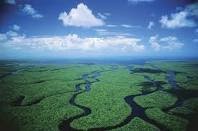
The Everglades, unique to the world, holds diversity and many forms of life.  The name Everglades is derived from an English chart maker that overtime the word River Glades was changed to Ever Glades.  The Indians most accurately called the Everglades: Grassy Water.  The Everglades is formed by the overflowing Lake Okeechobee.  Its location extends from the east and west sides of Lake Okeechobee to the very southern tip of Florida.  The river and grass combination provides the perfect environment for life.  This area covers over 3500 square miles.  The sheer size and importance of the Everglades in terms of biodiversity is genuine and crucial to the surrounding ecosystems because everything is linked.  The importance of the coastline becomes apparent especially for the mangroves as they hold back the sea, thus protecting the mainland.  The seasons of wet and dry that apply to Southwest Florida should be noted as the ecology adapts to the moderately changing seasons.  Marjory Stoneman Douglas did a remarkable job unlocking the secrets of the Everglades.  The many natural functions the Everglades provides to ecology and in turn humans, become evident when it is understood.  The Caloosahatchee River explanation is a special reminder of the closeness to nature especially since living in the rural area of LaBelle for years, that river also plays a vital role in the community there.  Recognizing the connection between the Everglades value to community and to the value of nature, The Everglades serves rewards to humans and ecology alike. 

Journal Entry 12- The Ecological Footprint

The Ecological Footprint
Energy Consumption can be reduced simply by making some behavioral or lifestyle changes.  Often times these changes will not have a drastic or even significant impact on the current human way of life, but will benefit the environment.  Some changes I could make to reduce my ecological footprint and promote conservation would be first to reduce my transportation impacts.  Using a smaller vehicle, carpooling more, and use alternative transportation means is a few solutions.  Using energy efficient appliances, living in homes with better insulation, and if possible buying a tank-less water heater would cut power usage significantly.  Unplugging electronics and using power bars will cut wasted electricity usage.  Modifying my eating habits will reduce my ecological footprint as well.  Purchasing local foods and organic when possible or when in season reduces impacts.   If possible, planting a garden would be the best food source.  Consuming less meat would contribute to cutting greenhouse gas emissions.  In housing, the use of drought tolerant plants will cut water usage and the energy associated with it.   Taking less frequent and shorter showers will also achieve the same goal.  Constantly repairing leaks and avoiding activities that demand high water usage makes a big difference.  This includes rarely washing the vehicle, using commercial car-washes, and not power-washing.  Adopting a combination of these behavioral changes will over time create a significant difference so reducing my ecological footprint now, and encouraging others to adopt a similar lifestyle, will provide a long lasting environmental benefit.