Welcome to Practical Sustainablity Solutions

This blog will provide the following functions to fulfill the requirement of environmental sustainability and FGCU University Colloquium's class in order to examine the current environmental, social, and economic situation. More importantly, based on these understandings supported by sound scientific evidence and reasoning, practical solutions to improve social and economic situations will be promoted for a mutually beneficial relationship.

Tuesday, April 19, 2011

Journal Entry 18- The Human Impact

Surviving the Human Impact
The overall human impact is vastly underestimated by many.  The behavior and impacts of a single individual may be so small, but people do not realize the vast quantities of humans.  Every ecosystem has a set carrying capacity.  The same is true for the earth and humans.  The colonies here can only sustain a set number of demands on the ecosystems before destruction will naturally occur.  This destruction can take place with the loss of natural resources that sustain plants and animals, and/or through natural disasters such as fires caused by drought (water overconsumption), or other naturally occurring disasters exemplified by human impacts on the earth’s resources.  The global populations numbering in the billions are barely sustainable since the vast majority of humans live in poverty in proportions vastly below the American standard of living.  Efforts to make necessary changes are definitely attainable however saving humanity as a whole and the standard of living of modernized humans is not possible, especially with the exponentially expanding size of populations.  Thus creates the moral dilemma and the ever present philosophy that the fittest survive.  The modernized nations are able to utilize education and technology to make life sustainable without compromising living standards.  This will not be true for underdeveloped and struggling nations simply because the resources are not plentiful enough to be sustained in higher levels.  Nations currently under development including developing markets should be trained in resource responsibility so the majority of populations (those with the current resource advantages) are sustained with the better lifestyle.  To make these changes are also possible through government and cultural policy making. 

Journal Entry 17- The Nature of the Everglades Reflection

The Nature of the Everglades Reflection
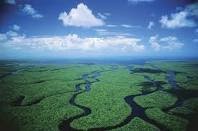
The Everglades, unique to the world, holds diversity and many forms of life.  The name Everglades is derived from an English chart maker that overtime the word River Glades was changed to Ever Glades.  The Indians most accurately called the Everglades: Grassy Water.  The Everglades is formed by the overflowing Lake Okeechobee.  Its location extends from the east and west sides of Lake Okeechobee to the very southern tip of Florida.  The river and grass combination provides the perfect environment for life.  This area covers over 3500 square miles.  The sheer size and importance of the Everglades in terms of biodiversity is genuine and crucial to the surrounding ecosystems because everything is linked.  The importance of the coastline becomes apparent especially for the mangroves as they hold back the sea, thus protecting the mainland.  The seasons of wet and dry that apply to Southwest Florida should be noted as the ecology adapts to the moderately changing seasons.  Marjory Stoneman Douglas did a remarkable job unlocking the secrets of the Everglades.  The many natural functions the Everglades provides to ecology and in turn humans, become evident when it is understood.  The Caloosahatchee River explanation is a special reminder of the closeness to nature especially since living in the rural area of LaBelle for years, that river also plays a vital role in the community there.  Recognizing the connection between the Everglades value to community and to the value of nature, The Everglades serves rewards to humans and ecology alike. 

Journal Entry 12- The Ecological Footprint

The Ecological Footprint
Energy Consumption can be reduced simply by making some behavioral or lifestyle changes.  Often times these changes will not have a drastic or even significant impact on the current human way of life, but will benefit the environment.  Some changes I could make to reduce my ecological footprint and promote conservation would be first to reduce my transportation impacts.  Using a smaller vehicle, carpooling more, and use alternative transportation means is a few solutions.  Using energy efficient appliances, living in homes with better insulation, and if possible buying a tank-less water heater would cut power usage significantly.  Unplugging electronics and using power bars will cut wasted electricity usage.  Modifying my eating habits will reduce my ecological footprint as well.  Purchasing local foods and organic when possible or when in season reduces impacts.   If possible, planting a garden would be the best food source.  Consuming less meat would contribute to cutting greenhouse gas emissions.  In housing, the use of drought tolerant plants will cut water usage and the energy associated with it.   Taking less frequent and shorter showers will also achieve the same goal.  Constantly repairing leaks and avoiding activities that demand high water usage makes a big difference.  This includes rarely washing the vehicle, using commercial car-washes, and not power-washing.  Adopting a combination of these behavioral changes will over time create a significant difference so reducing my ecological footprint now, and encouraging others to adopt a similar lifestyle, will provide a long lasting environmental benefit. 

Tuesday, April 12, 2011

Journal Entry 14- Reflection on Service Learning Experience (part 2)

Communication between the Green Team Leadership was essential in providing direction and progress reports throughout the planning of the event.  To further market the event I used the popular social networking utility Facebook to target the FGCU student and faculty market segment.  The Facebook friend Green Eagles also provides a supportive environment to learn about not only The Green Team, its mission and events, but also has become a link between all conscientious students with concern for practical sustainability living behaviors.   It also allows people to become a more responsible citizen or a proactive supporter for environmental sustainability.   Already this utility has gained around 80 friends and is rapidly being sought by students and faculty alike to become friends and then become involved.  The Sustainability Coordinator at FGCU has learned of this organization through Green Eagles and has specifically requested to be involved and even offered support for our future initiatives.   Green Eagle Festival in particular teamed up with university departments such as the Office of Housing and Residence Life, Student Government and The Office of Student Involvement but also attracted numerous environmentally conscience student organizations including Eco-Action.  Overwhelming response from the our Florida Gulf Coast University Community and organizations/businesses in our surrounding community has made the countless hours spent ensuring the success of the event by our leadership and volunteers was made worthwhile.  Future programs and initiates will continue to shape culture in a direction where people adopt practical sustainability solutions. 

Journal Entry 13- Reflection on Service Learning Experience

Journal Entry 13- Reflection on Service Learning Experience (part 1)
Green Team is a student organization supported by the Office of Housing and Residence Life.  The mission of The Green Team is to promote sustainable living standards in housing.  This mission supports environmental initiatives and recognizes the ecological importance of our environment.  Education is the first step to creating a responsible culture and starting at home with simple knowledge is practical and highly effective. 
As a staff member of the Office of Housing and Residence Life I was also able to maximize the potential of our efforts by doubling this Florida Gulf Coast University campus event as a specific housing program to increase attendance so that residents along with all students were able to benefit as much as possible from the event.  Green Team was looking for volunteers to help plan and execute their new Green Eagle Festival.  I choose to be proactively involved throughout the entire event and became named the Green Eagle Event Coordinator.  Leadership comes from being proactive and seizing the opportunities that are always presenting themselves.  The Green Team Sponsor is Deidra Cassella, a Housing GA.  The initial duties of the position required coordinating the outside organizations that planned on participating to improve the overall success of the event.  Participation included managing paperwork between housing and the Campus Reservations Department.  Communication and organization was key to fulfilling the duties and responsibilities awarded by the position.  To set up communications I opened a new email address greeneagleevents@live.com. 

Tuesday, March 15, 2011

Journal Entry 8- Reflections on Gary Gardner Articles

Religion and the Quest for a Sustainable World:
Engaging Religions to Shape Worldview:
Ritual and Taboo as Ecological Guardians:
Religious institutions are powerful and carry great influence.  The environmentalist movements will be amplified if the support of those institutions can be won.  When pursing like interests it is a wise decision to team up and unite similarities.  The passages note that an ethical dilemma exists when using religion as a means to push an agenda.  Religion is a powerful influence in politics, business, and culture already so involvement itself is not unethical however stating that people of an entire faith supports a particular agenda would be foolish and highly unethical.  It would be better to position itself behind its members who support the agenda for the same religious reasons those institutions support. 
The claim that ecological crises extend to culture and human spirit can be substantiated with science in that humans are part of nature and our spirit is affected by survivability.   Using religion as a means of control is dangerous because anything that distracts from religious messages not inherent to that religion could be sinful.  Cultures have used the institution of religion as a means of control throughout history however for the religious there can be serious repercussions to that kind of influence especially since faith is not all substantiated or denounced through science.  Often time’s religion uses faith as a way to teach peoples how to live and survive without providing the reasons for that behavior.  The links drawn between consumerism and greed discussed in many religious perspectives substantiate that claim. 
Creating rituals and taboos to reform culture would eventually reach a culture behaving in a similar fashion however; this is the same thing as revising tradition to a more sustainable fashion.  Rather than implementing resorting to very old rituals and taboos it would be more effective to create a campaign to reform how we practice our current traditions.  Typical rites of passages have been consumed by consumerist ideals adding heavy financial and environmental costs.  Not only is there an argument for environmental sustainability but there is also an argument for getting consumerism out of the way of the actual purpose and principal of these occasions.